Most garages and two-story structures need township-approved plans. For many of our standard designs those building drawings are already done and included at no extra cost. If your township also requires sealed, engineer-stamped drawings, those are prepared by an outside licensed engineer for an added cost — and your $25 review tells you up front whether yours is one that needs them.
Permits trip a lot of people up — that's exactly why we do this. For a one-time $25 review, we look at your specific build and your township, then get back to you with whether it can be permitted and what it would take. Most projects can move forward, but not every lot qualifies — setbacks, zoning, easements, or HOA rules can limit or rule one out, and if that's your situation we'll tell you straight. Everything depends on what your township asks for, and we quote you those numbers up front before you spend another dollar. When a township is vague about what it wants — plenty of them are — we get on the phone and pin it down for you, so you end up with a real answer instead of a runaround.
Your first step — no guesswork
$25
applied to your purchase
The $25 pays for the work of finding out whether your project can be permitted — approval is never guaranteed. It comes straight off your build price when you move forward, and covers our research time either way.
Every township is a little different. After your review, we'll tell you which of these apply to you — and what each one costs — before anything moves forward.
A site / plot plan
An overhead drawing showing where the building will sit on your property. We help you put it together — but we need you to tell us where on your lot you want it placed. Without that from you, the permit can't move.
Drawings of your building
Plans of the exact structure you're ordering. For most of our standard designs these are already drawn and on file. A brand-new custom layout is a one-time drawing fee.
Sealed (engineered) drawings
Some townships require a licensed engineer's stamp. These are prepared by an outside engineer, cost more than the $25, and that engineering portion is non-refundable once ordered. We'll tell you up front if yours is one of them.
HOA approval, where applicable
If your neighborhood has a homeowners association, they may need to sign off too. We'll flag it during your review so it doesn't catch you by surprise later.
The $25 review, plus whatever drawings your township needs for your specific build. We quote you the exact amount after the review — never a surprise, and never a number that changes on you.
Its own permit fee, set by the township and paid to them — it varies by location. We'll tell you the amount. You can add it to your purchase and we'll submit it for you, or pay your township directly if you'd rather have the permit approved before you commit to the build.
Not sure where to start? Call us at (610) 857-3420 and we'll walk you through it.
For simple, smaller buildings we handle the whole permit process for you. But for larger or double-wide structures — anything 16 ft wide and up — approval takes more legwork, and the single biggest thing that gets these across the finish line is you being willing to go to the township and talk with them personally. We prepare everything and coach you on exactly what to say, but a local homeowner advocating for their own project moves the needle in a way we simply can’t do remotely.
What a township prints on its paperwork doesn’t always reflect what they’ll actually approve in person — which is exactly why your involvement makes the difference on bigger builds. Think of it as a team effort: we do the heavy lifting, and your willingness to show up is often what gets a larger structure approved.
Double-wide / oversized reviews are $75 (vs $25 for standard single-wide builds) because they involve significantly more work. Just like the $25, that $75 credits straight to your build when you move forward.
Below is a sample 24x24 two-story garage plan set. Watermarked previews shown — full engineering plans are provided with your order.
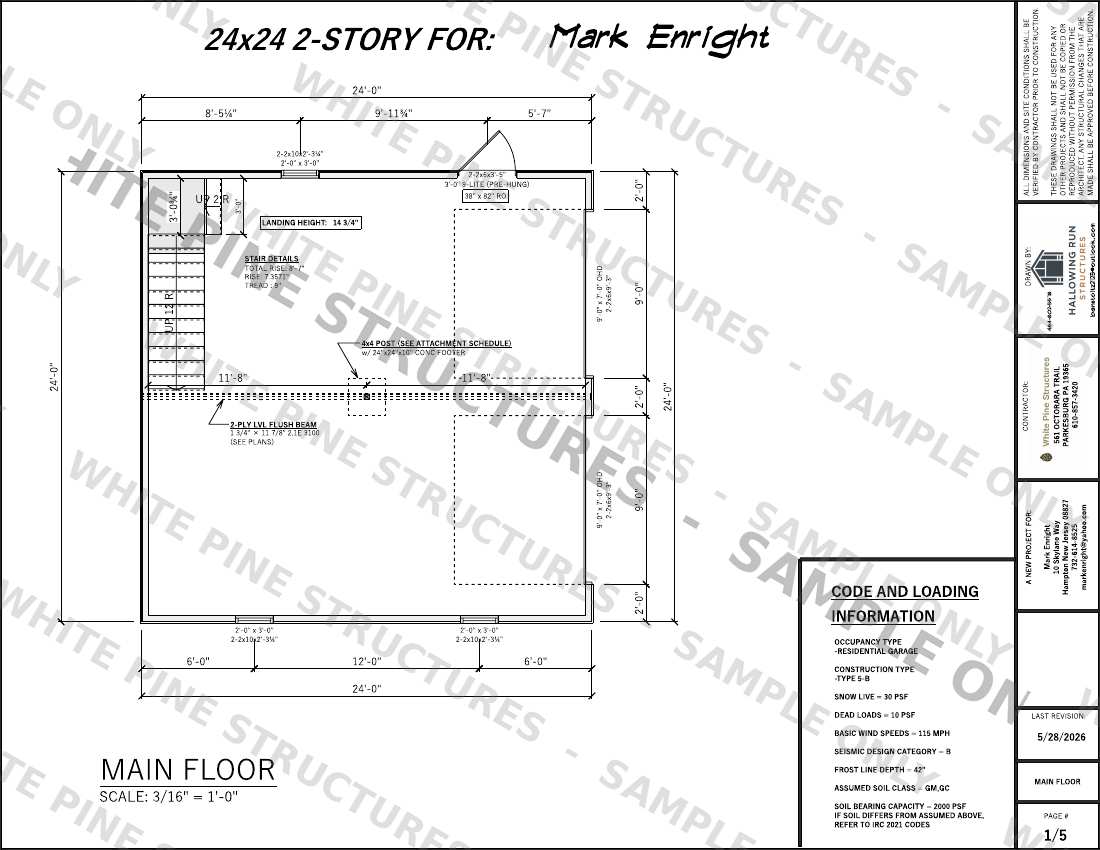
Full dimensional layout with stair details, beam locations, and code compliance information.
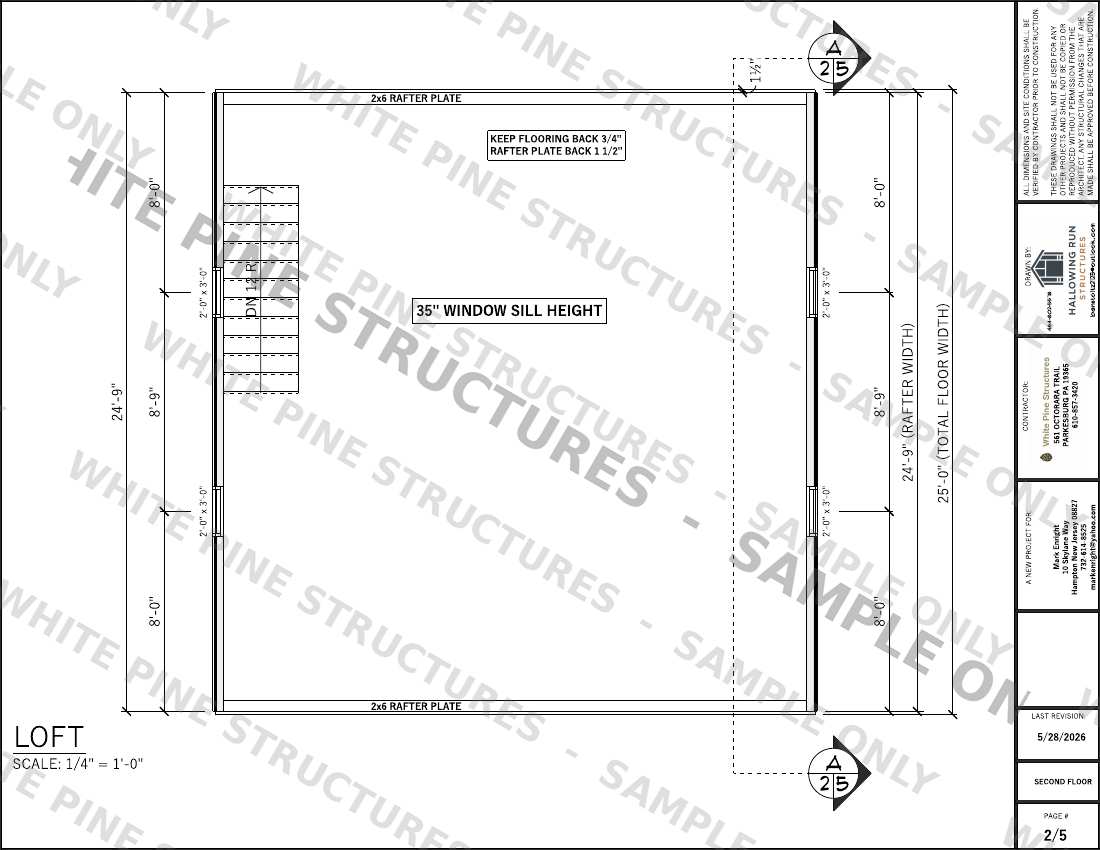
Upper level layout showing guardrail placement, floor joist spacing, and opening locations.
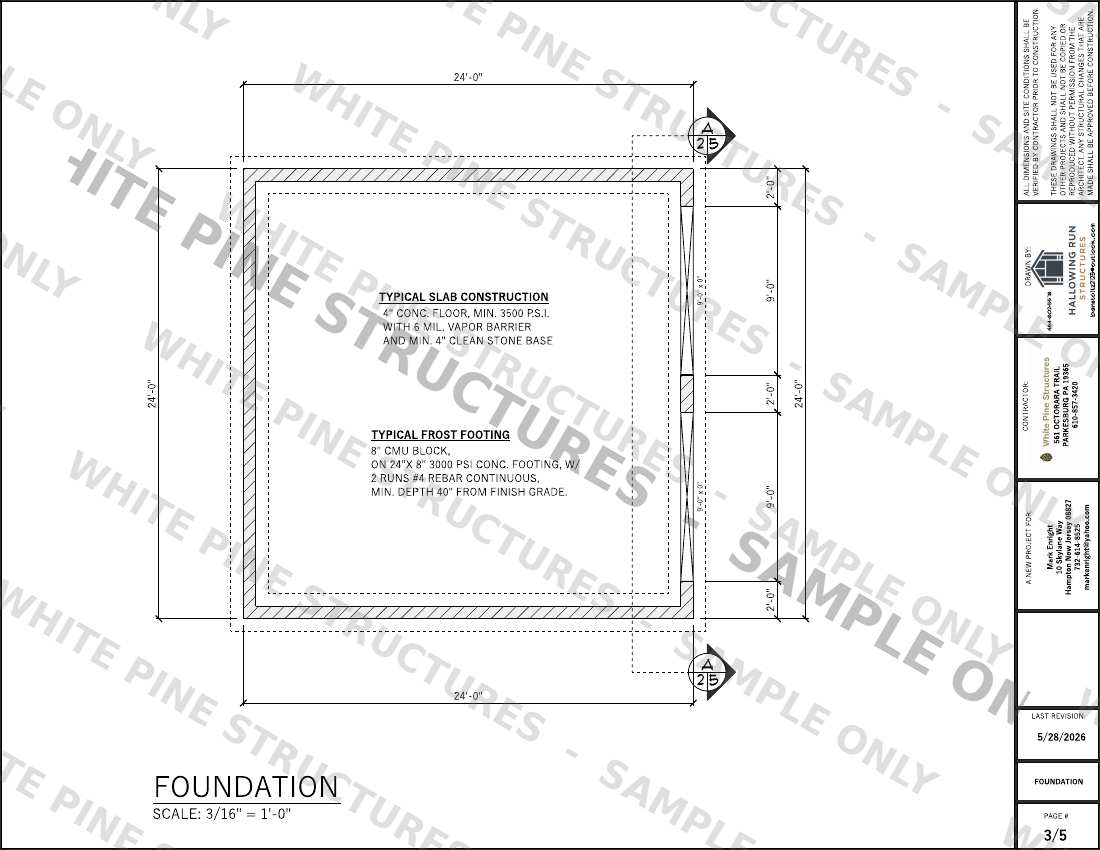
CMU block layout with frost footing details, anchor bolt spacing, and rebar specifications.
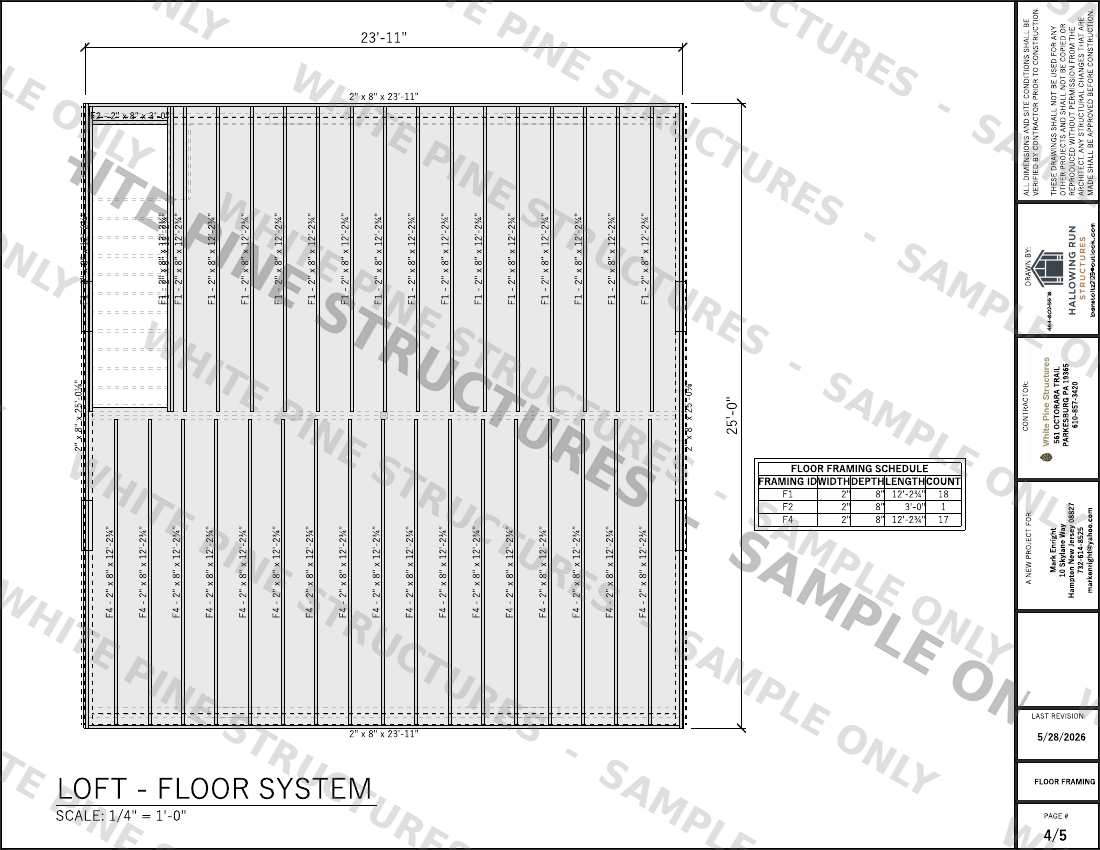
Joist layout, beam sizing, and structural connection details for the subfloor system.
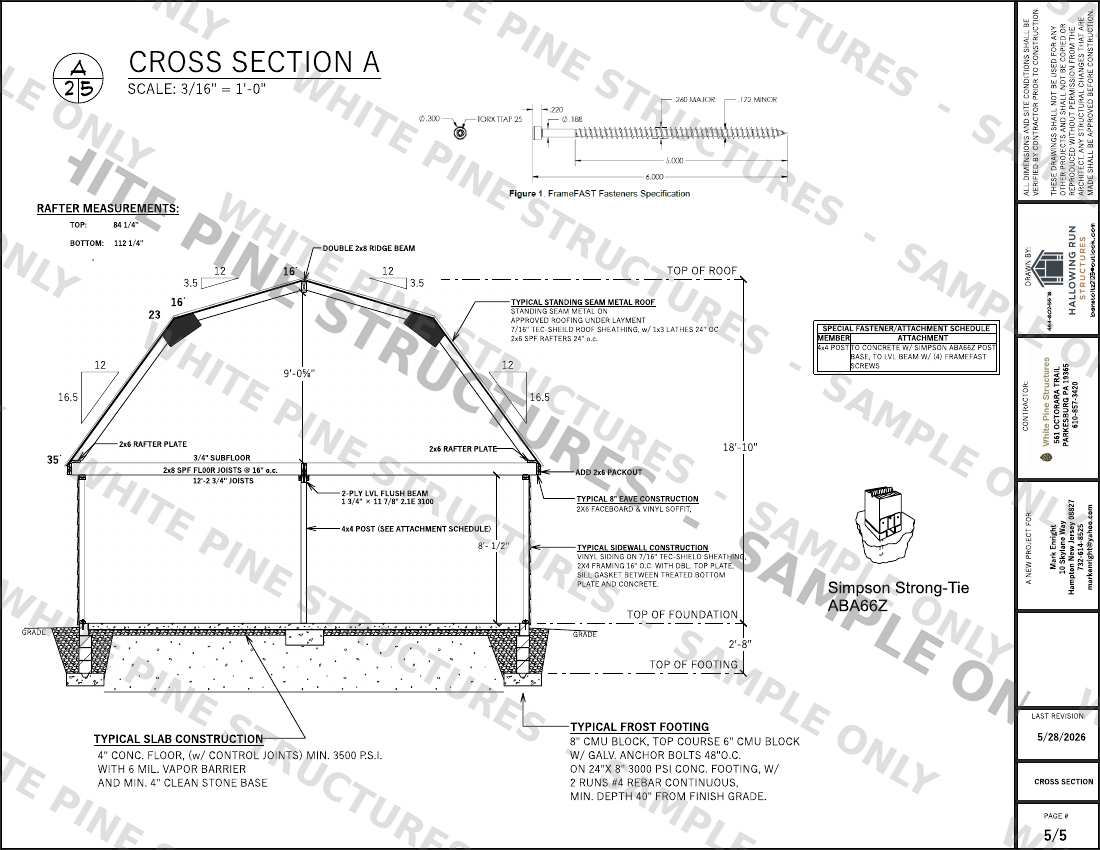
Full building cross section showing roof framing, wall construction, Simpson Strong-Tie connections, and foundation details.
Note: These are low-resolution watermarked previews. Full-detail plans are provided with your order. Customer name shown is for sample purposes only.
Every plan set references IRC 2021 residential code with site-specific loading data — snow loads, wind speeds, seismic category, and frost line depth. Your township sees exactly what they need.
Simpson Strong-Tie hardware is called out at every critical connection — post-to-beam, rafter-to-plate, and post-to-concrete. No guesswork for the inspector.
Frost footing specs, CMU block layout, anchor bolt spacing, rebar requirements, and slab construction details are all drawn and dimensioned. Ready for your concrete contractor.
Plans are drawn by Hallowing Run Structures, a professional structural design firm. Each set is project-specific — not generic templates — customized to your exact size and configuration.
Most townships in Chester County and surrounding areas require a “plot plan” or “site plan” as part of your permit application. Here’s the good news: it’s simpler than you think.
A plot plan is a simple overhead drawing of your property that shows where your existing house sits, where the proposed structure (your new garage or shed) will go, and the distances to property lines (called setbacks). It helps the township verify your project meets local zoning requirements.
Important: A plot plan is NOT the same as a professional land survey. Most townships accept a hand-drawn or printed sketch — you do not need to hire a surveyor.
Property Lines & Dimensions
Show the outline of your lot with approximate measurements. Your deed or county GIS map will have these.
Existing Structures
Mark your house, driveway, any other buildings, septic, and well locations if applicable.
Proposed Structure Location
Draw your new garage or shed in the planned position with its footprint dimensions (e.g., 24’ × 32’).
Setback Distances
Measure and label the distance from your proposed structure to each property line. Your township’s zoning ordinance specifies minimum setbacks.
Send us your address and we can pull your property info from the county GIS system. We’ll help you fill it in — no charge.
Not sure what your township requires? Call us — we'll tell you whether your build needs new plans or if we already have them on file. Most standard designs are already drawn and included free.